Monday, May 23, 2005

Automated textual coordination 1.0

Mostly, this is an excuse to play with a neat online toy, "Spell with flickr", by Kastner. But it also shows that by executing rules for coordinating texts, scripts can automate some processes that would take quite a bit of time to do by hand.

T square up closeEXt

[Actually, I had to hand-paste the auto-generated HTML because Blogger wont allow Kastner's java. But it's still pretty nifty.]

Healthy Technological Criticism

In his recent post "The right tool for the job", Jason Fried over at Signal vs. Noise shows the kind of critical thinking about technology that I'm hoping to teach my students. He does a great job ackowledging that any technology is only one of several possible solutions for a given situation and it's that situation or context that should drive one's choice of technologies.

Amen Jason!

Friday, May 20, 2005

Taking Notes


Taking Notes
Originally uploaded by
philgyford.

This blog serves as a sort of zoo where I can collect specimines of writing phenomena related to my research. Today's exhibit is a wonderful example of textual co-location and remediation found in the wild.

Phil Gyford has posted this Flickr image of his life-hack/notetaking system. He's got a carfully managed process of taking Post-It notes while reading, then transposing them to the web so that he (and others!) might use them.

Friday, May 06, 2005

Amazon's "Statistically Improbable Phrases"

Wired explores Amazon's new "Statistically Improbable Phrases" -- unusual word strings based on statistical analysis of word frequency and data mining. The technique is also producing concordences of Amazon's offerings.

I tried Umberto Eco's Name of the Rose and the list included "dead monks" and "treasure crypt" (well, and "heptagonal room" -- probably one of the more statistically improbable word string one might hope to unearth).

I'm intrigued by the idea of SIPs as authorial fingerprints. Hunter S. Thompson is one of the only authors I know who regularly uses "atavistic" but curiously, "invective screed" was nowhere to be found.

Wednesday, May 04, 2005

Video killed the text-based star

Christina Wodtke over at Elegant Hack pointed me to Jon Udell's screencast "Heavy metal umlaut: the movie" in which he tracks the development of Wikipedia's Heavy metal umlaut page. While the content of the screencast is fascinating enough, it's Udell's combined use of Wikipedia's page edit history and screen capture software to create a captivating instructional video that really got me thinking, "This is the future of online education in writing."

Friday, April 29, 2005

Better Research through Better Technology

I just came across a note I made while watching the December 20, 2004 Charlie Rose interview with Sir Paul Nurse, Nobel Prize winner and Joint Director General of Cancer Research UK.

Nurse discussed the important role of technological innovations in research for driving changes in thinking about science. He described better understanding as a being a result of more precise instruments for measuring and imaging physiological (and other) phenomena.

I was wondering why that hasn't been the case with writing studies.

Saturday, April 23, 2005

Autopen and the distant hand of authorship

This somewhat recent Talk of the Town from the New Yorker raises some interesting questions about what happens when a writer is physically removed from the writing he or she is doing. I find it facinating that, despite Margaret Atwood's argument, remote signing doesn't feel the same.

Even more intersting, to me at least, is how similar Autopen looks to Thomas Jefferson's polygraph machine. Really, I guess its just a matter of scale as to how removed the writer is from writing on each machine. La plus ca change...

DAMILIC Corporation's Autopen [from damilic.com]
Posted by Hello


Jefferson's polygraph [from monticello.org] Posted by Hello

Also mentioned in the Talk piece, LeapFrog’s FLY pentop computer and Margaret Atwood's tragically named Unotchit "gizmo".

Thursday, April 21, 2005

Thursday, April 14, 2005

Annotate your childhood

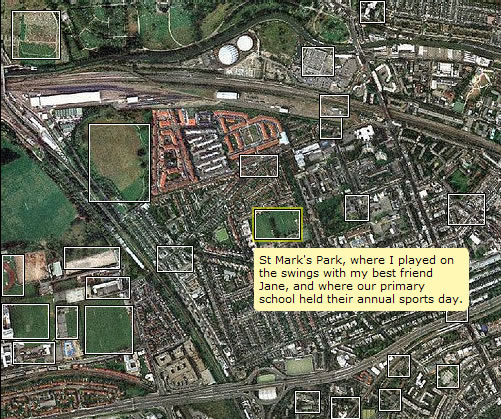
My new favorite Cool Tool is Google Map's satellite imagery feature. Lots of folks have been spending time clicking and dragging around the locations of their past and present, leading to the phenomenon of Memory Maps. This annotated example from megpickard's photostream is just too cool.

Annotated memory map [from megpickard's photostream]
Posted by Hello