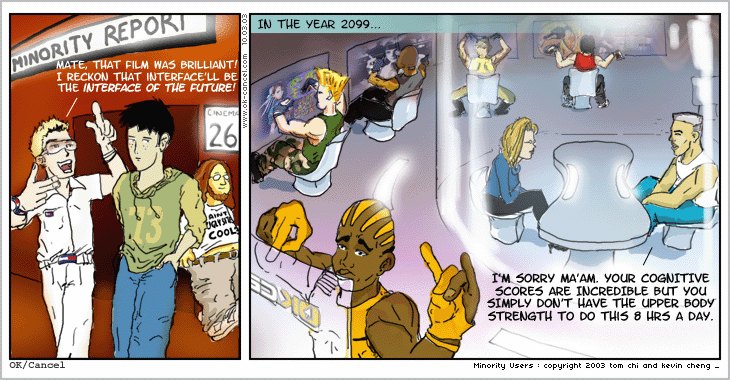
[From: OK/Cancel]
There was also the climactic scene where, for some reason, a file had to be physically removed from one screen and walked over to another. Yeah right, all that futurism and still the climax relies on sneakerware.
Technology forces us to juggle competing demands on our attention over the course of our workdays. Alex Chadwick speaks with New York Times Magazine contributor Clive Thompson about "interruption science," the study of the effect of disruptions on job performance.The research isn't as productivity-driven as it sounds. In fact, much of it echoes Johnson-Eilola's Datacloud which I'm re-reading. For example...
No link yet for article they're talking about. [Update: Ah, here it is, via 43 Folders.]
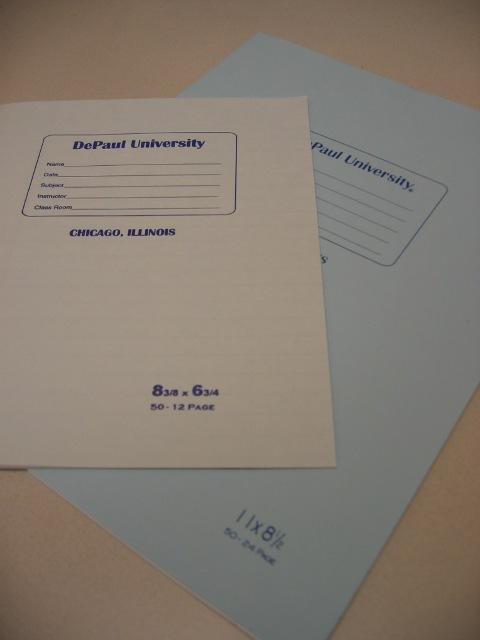 One danger in research is the desire to interpret all findings as meaningful. Here’s an interesting example from our campus bookstore…
 A colleague of mine, knowing my interest in such things, notified me of a change in the size of our blue exam books, from 8 3/8 x 6 3/4, 12-page to 8 1/2 x 11, 24-page:
“How interesting,” I thought. I began to hypothesize: “I wonder if they had complaints about the old smaller books. I wondered if students filled more than one during exams and faculty ran into problems grading multi-book responses. Or perhaps more exams were requiring more writing. Wouldn’t that be something!” So I wrote to our bookstore manager to inquire about the reason for the change. The answer?
We ran out. We will replentish (sic) and have both sizes.
Ah, of course. How silly of me to forget Occam’s razor: The simplest answer is usually preferable.
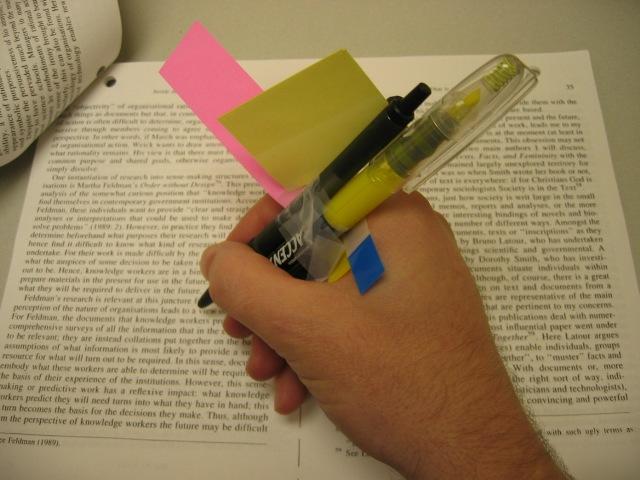
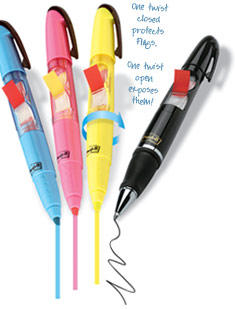 "Post-it® Flag Highlighters and Pens" -- while innovative and perhaps useful, this company's product proliferation is getting as bad as Oreos'.
...the point at which a new technology gives the broad public access to tools once considered the domain of a specific profession, resulting in an explosion of artifacts. Most of these artifacts will be badly produced, but a few will be genuine innovations, and the artifacts will eventually regain regularity as the public acquires a more discriminating eye (and templates).Are the bad artifacts the result of unskilled folks or bad technology? Probably both, but I think two recent changes to typical PowerPoint presentation styles are beginning to combat so-called Powerpointlessness -- the "Lessig Method" (from Presentation Zen) and the Kawasaki & Takahashi Methods (from Presentation Zen and 37 Signals).
I even use Track Changes myself when writing a paper. I like to have the original draft embedded in even my sixth or seventh draft, since it is in essence the same document, just with lots of different colors.[via: Coherent Fragments]
In a sense, using Track Changes enables me to develop my thoughts more thoroughly and clearly. And days later, when I'm reading and re-working the paper again, I don't have to wonder where a thought was coming from. My entire thought process is right there embedded in the text. It doesn't seem static to me because I can see how things developed from my initial ideas.
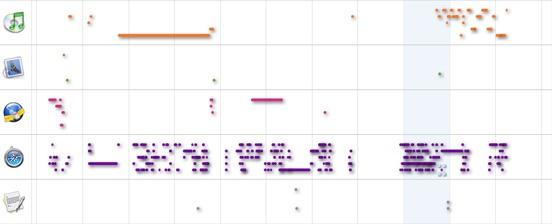
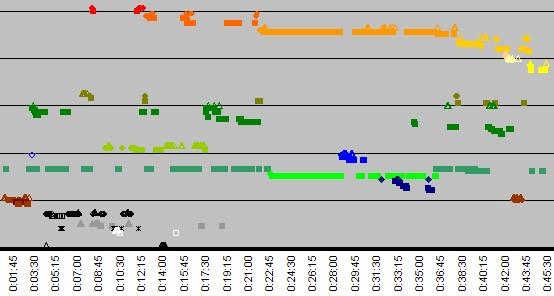
[Onlife] observes your every interaction with software applications... and then creates a personal shoebox of all the web pages you visit, emails you read, documents you write and much more... then indexes the contents of your shoebox, makes it searchable and displays all the interactions between you and your favorite apps over time.The idea isn't too far off from this project (from Bill, Clay Spinuzzi, and Mark Zachary), which seeks to reveal patterns of communication among people rather than an individual user's patterns of software use. And Onlife's visualization displays look quite similar to my own research data charts of writers' object use over time: