Tuesday, August 30, 2005
Co-locating Text as Life-Hack
Giles Turnbull over at O'reilly describes his attempt to "organise all my work, all my personal stuff, all my writing, in one huge text file?" -- the most extensive attempt at textual coordination I've heard to date. Read his post and the 43 Folders post that told me of the attempt to learn more about the rationale and pros and cons of the approach.

Friday, August 26, 2005
"The great-great-grandfather of the Hipster PDA"
43 Folders links to a blurb about life-hacking forefather Thomas Jefferson's portable note-taking device.

Jefferson's hipster PDA [from monticello.org]
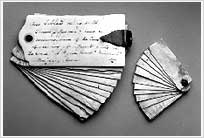
Jefferson's hipster PDA [from monticello.org]

Speaking in Ignorance (of Audience and Context)
I now know how my students feel. In my field, student writing is often criticized for being poorly thought out. I believe bad communication is more the fault of ignorance about the situation in which it will be used. And students, through the mere fault of being young and inexperienced, are often ignorant of the contexts in which writing occurs. This happened to me yesterday with my voicemail.
- record your name
- record a message for external calls (coming from outside of DePaul)
- record a message for internal calls (coming from within DePaul)
- "Shaun Slattery" (I had the option of also stating the extension number. I decided against it, but don't know if that was a good or bad decision.)
- "This is Shaun Slattery at DePaul University; I can't take your call right now. Please leave a message and I'll get back to you."
- "This is Shaun Slattery in the Department of English. Please leave a message and I'll call you back."
Thursday, June 02, 2005
CFP: TechComm special issue
Clay Spinuzzi will be editing a special issue of Technical Communication Quarterly, "Technical Communication in the Age of Distributed Work." See the full call for papers; here's a taste:
It goes by many names: Distributed capitalism, the control society, the informatics of domination, the support economy. Whatever its name, the characteristics are the same: control over organizations is as distributed as ownership is in managerial capitalism; digital technologies play a vital enabling role; consumption is individuated, taking the form of the desire for unique identities and unique experiences; direct relationships between customers and businesses become more important; and customers look for stable beneficial relationships among consumers and producers that support these individual experiences. These needs are supplied not by large, vertically integrated companies but by temporary "federations" of suppliers for each individual transaction. These federations are endlessly recombinant. Work is fragmented temporally, geographically, and disciplinarily.Schedule:
What does distributed work mean to us as technical communicators? How is it changing our field? Should we adapt to it, critique it, or resist it? In this special issue of Technical Communication Quarterly, we will discuss distributed work's implications for technical communication theory, methodology, pedagogy, ethics, and practice.
- 1-2 page proposal for paper: March 15, 2006
- Full paper (if proposal is accepted): June 30, 2006
- Scheduled publication of issue: Summer 2007
Contact information: Send proposals in .DOC, .RTF, or .HTML to
Clay Spinuzzi, clay.spinuzzi[at]mail.utexas.edu
Monday, May 23, 2005
Automated textual coordination 1.0
Mostly, this is an excuse to play with a neat online toy, "Spell with flickr", by Kastner. But it also shows that by executing rules for coordinating texts, scripts can automate some processes that would take quite a bit of time to do by hand.


[Actually, I had to hand-paste the auto-generated HTML because Blogger wont allow Kastner's java. But it's still pretty nifty.]
[Actually, I had to hand-paste the auto-generated HTML because Blogger wont allow Kastner's java. But it's still pretty nifty.]
Healthy Technological Criticism
In his recent post "The right tool for the job", Jason Fried over at Signal vs. Noise shows the kind of critical thinking about technology that I'm hoping to teach my students. He does a great job ackowledging that any technology is only one of several possible solutions for a given situation and it's that situation or context that should drive one's choice of technologies.
Amen Jason!
Amen Jason!
Friday, May 20, 2005
Taking Notes

This blog serves as a sort of zoo where I can collect specimines of writing phenomena related to my research. Today's exhibit is a wonderful example of textual co-location and remediation found in the wild.
Phil Gyford has posted this Flickr image of his life-hack/notetaking system. He's got a carfully managed process of taking Post-It notes while reading, then transposing them to the web so that he (and others!) might use them.
Tuesday, May 10, 2005
STC Conference Presentation
Whew -- just returned from Seattle and STC's 52nd Annual Convention where I presented "Experiencing Technical Writing as Textual Coordination"
Friday, May 06, 2005
Amazon's "Statistically Improbable Phrases"
Wired explores Amazon's new "Statistically Improbable Phrases" -- unusual word strings based on statistical analysis of word frequency and data mining. The technique is also producing concordences of Amazon's offerings.
I tried Umberto Eco's Name of the Rose and the list included "dead monks" and "treasure crypt" (well, and "heptagonal room" -- probably one of the more statistically improbable word string one might hope to unearth).
I'm intrigued by the idea of SIPs as authorial fingerprints. Hunter S. Thompson is one of the only authors I know who regularly uses "atavistic" but curiously, "invective screed" was nowhere to be found.
Wednesday, May 04, 2005
Video killed the text-based star
Christina Wodtke over at Elegant Hack pointed me to Jon Udell's screencast "Heavy metal umlaut: the movie" in which he tracks the development of Wikipedia's Heavy metal umlaut page. While the content of the screencast is fascinating enough, it's Udell's combined use of Wikipedia's page edit history and screen capture software to create a captivating instructional video that really got me thinking, "This is the future of online education in writing."
Subscribe to:
Posts (Atom)
