Wednesday, January 24, 2007
Grammar
Several recent discussions of grammar have highlighted for me people's concern for grammatical correctness. My Writing in the Professions class just read "The Politics of Grammar and Usage" in John Bean's Engaging Ideas. The recent CNN.com coverage of the Grammar Girl blog just came across the ATTW listserv. A short article in last month's Wired (scroll down) answers the question, "Chatting online is ruining my kids’ spelling and grammar. Should I stop them from doing it?" And I just learned that Purdue's Online Writing Lab is serving more pages than ever before.

Friday, December 15, 2006
8-bit Post It Fun
As often as I use Post-It Notes, it never occurred to me to do this:
[*cough*cough* Need to clear the dust and cobwebs here. The diss is complete, so more posts soon!]
[*cough*cough* Need to clear the dust and cobwebs here. The diss is complete, so more posts soon!]
Wednesday, September 20, 2006
Ruled paper for writing Arabic
Learning to write on lined paper when we are very young tends to make those lines feel so Authoritative -- rigid, constant, unvarying.
Different writing systems require different kinds of lines. The lines come after the writing. But when they are given to us before we can write in order to help constrain our wobbly letters, they feel like they came before.
On a related note, I've experimented with writing of a variety of kinds of paper -- ruled, college ruled, graph, engineering graph, blank... None of them have any effect on my writing. I write all over the damn page, draw diagrams wherever I please, send arrows careening 'round the page to connect thoughts. And there hasn't been a line invented yet that can constrain my wobbly letters. My penmanship suggests mercury poisoning.

Different writing systems require different kinds of lines. The lines come after the writing. But when they are given to us before we can write in order to help constrain our wobbly letters, they feel like they came before.
On a related note, I've experimented with writing of a variety of kinds of paper -- ruled, college ruled, graph, engineering graph, blank... None of them have any effect on my writing. I write all over the damn page, draw diagrams wherever I please, send arrows careening 'round the page to connect thoughts. And there hasn't been a line invented yet that can constrain my wobbly letters. My penmanship suggests mercury poisoning.
Sunday, September 17, 2006
The Beauty of Ugly
Ze Frank gets it right about the value of putting the means of production into the hands of the masses! His "I knows me some ugly Myspace showdown" contest prompted exchange below that was so damn good and spot-on, I just had to transcribe and post it. Rock on Ze!
[Naturally, after transcribing, I found the wiki.]
S-s-s-something from the comments. Marion writes, "Having an ugly Myspace contest is like having a contest to see who can eat the most cheeseburgers in 24 hours. You're mocking people who, for the most part, have no taste or artistic training." Marion, thanks for telling me what I was doing. I didn't even know I was mocking people.
For a very long time "taste" and "artistic training" have been things that only a small number of people have been able to develop. Only a few people could afford to participate in the production of many types of media. Raw materials like pigments were expensive, same with tools like printing presses. Even as late as 1963, it cost Charles Peignot over $600,000 to create and cut a single font family.
The small number of people who had access to these tools and resources created rules about what was "good taste" or "bad taste". These designers started giving each other awards and the rules they followed became even more specific -- all sorts of stuff about grids and sizes and color combinations -- lots of stuff that the consumers of this media never consciously noticed.
Over the last 20 years, however, the cost of tools related to the authorship of media has plummeted. For very little money, anyone can create and distribute things like newsletters, or videos, or bad-ass tunes about Ugly. Suddenly, consumers are learning the language of these authorship tools. The fact that tons of people know names of fonts, like Helvetica, is weird!
And when people start learning something new, they perceive the world around them differently. If you start learning how to play the guitar, suddenly the guitar stands out in all the music you listen to. For example, throughout most of the history of movies, the audience didn't really understand what a craft editing was. Now, as more and more people have access to things like iMovie, they begin to understand the manipulative power of editing. Watching reality TV almost becomes like a game as you try to second guess how the editor is trying to manipulate you.
As people start learning and experimenting with these languages of authorship, they don't necessarily follow the rules of "good taste". This scares the shit out of designers. In Myspace, millions of people have opted-out of pre-made templates that "work" in exchange for Ugly. Ugly when compared to pre-existing notions of taste is a bummer, but Ugly as a representation of mass experimentation and learning is pretty damn cool.
Regardless of what you might think, the actions you take to make your Myspace page Ugly are pretty sophisticated. Over time, as consumer-created media engulfs the other kind, it's possible that completely new norms develop around the notions of "talent" and "artistic" ability.
Happy Ugly. This is Ze Frank thinking so you don't have to.
[Naturally, after transcribing, I found the wiki.]
Monday, September 11, 2006
Technology and the Scale of Interaction
The announcement of The Chronicle of Higher Education's "Strategies for Campus Leadership" Technology Forum caught my eye today. Not that wee wonks like me have much voice at such things, but a sentence from the description of closing keynote speaker Peter Nicholson's (president and chief executive officer, Council of Canadian Academies) session disturbed me. It states,
My "scale of interaction" idea comes from McLuhen and my "different kinds of expertise" idea come from Robert Johnson (no, not that one). Which you, dear reader, now have easier access to because of the miracle hyperlinking.
Academics are accustomed to being regarded as the experts on any given topic. But with the arrival of blogs and Wikipedia, the Internet may be tearing down traditional structures of authority. Now everyone is an "expert." A prominent Canadian academic will discuss what this means for higher education.Sentence one is fine, and I can even understand how sentence two may be valid, but sentence three strikes me as flat-out wrong. Information technology does not create new experts, rather, it merely changes the scale of interaction among existing participants. It increases access. So really, it just forces us to notice and acknowledge other experts who previously didn't have access to us, our classrooms, or our published conversations. And I think acknowledging that "other" experts existed prior to digital technology has important implications for "what this means for higher education".
My "scale of interaction" idea comes from McLuhen and my "different kinds of expertise" idea come from Robert Johnson (no, not that one). Which you, dear reader, now have easier access to because of the miracle hyperlinking.
Wednesday, September 06, 2006
Academic peer-review moves online
"Get Wiki With It; Peer review – the unsung hero and convenient villain of science – gets an online makeover."
This interesting article in the current issue of Wired discusses a few recent examples of online peer-review for academic articles (article gets posted online and opened to comments from anyone) that differ from the traditional peer-review model (article gets sent out to review by a handful of peers).
The article points to a few examples of online peer review:
The Wired article does a decent job glossing a few of the pros and cons of each model, including some interesting related issues ("Nature is an elite journal that accepts few submissions, a kind of exclusivity that lets universities use publication as a proxy for worth in hiring and promotion decisions"). But Nature's examination of the issues is more thorough.
This interesting article in the current issue of Wired discusses a few recent examples of online peer-review for academic articles (article gets posted online and opened to comments from anyone) that differ from the traditional peer-review model (article gets sent out to review by a handful of peers).
The article points to a few examples of online peer review:
- Nature is currently experimenting with online review.
- arXiv (x = chi, thus archive) hosted by Cornell University Library, allows "Open access to 383,063 e-prints in Physics, Mathematics, Computer Science and Quantitative Biology" and includes a nice statement of rationale.
- Biology Direct, which according to Wired, "publishes any article for which the author can find three members of its editorial board to write reviews." [Biology Direct's self-description.]
- PLoS ONE which describes itself as an "inclusive, peer-reviewed, open-access resource from the Public Library of Science"
The Wired article does a decent job glossing a few of the pros and cons of each model, including some interesting related issues ("Nature is an elite journal that accepts few submissions, a kind of exclusivity that lets universities use publication as a proxy for worth in hiring and promotion decisions"). But Nature's examination of the issues is more thorough.
Monday, September 04, 2006
Technology of the Mundane
I think that after we use a technology for quite some time, we begin to take it for granted. (Though a broken washing machine, dishwasher, etc. is quick to change that situation.) But with mundane, everyday, "little" technologies, it's easy to forget what life was like before that technology existed and possibly even what situation or problem it was invented to overcome.
Thus my fascination with this post on the Modernmechanix blog about the "new" spiral bound notebook from the September 1934 Popular Science. A flexible memorandum book was an innovation, presumably because rigid notebooks were disadvantageous in some way. (Uncomfortable in the pocket? Can anyone think of other possible disadvantages to rigidity?)
So the next time you pick up a spiral-bound notebook, pause a moment to ponder what innovative soul wouldn't stand for the rigid ones. No, they introduced the innovation of spiral binding for flexibility. This goes for other mundane technologies: paper clips, office "binder" clips, ball point pens, etc., etc. Thank you noble innovators everywhere.
[via BoingBoing, image from Modernmechanix.com]

Thus my fascination with this post on the Modernmechanix blog about the "new" spiral bound notebook from the September 1934 Popular Science. A flexible memorandum book was an innovation, presumably because rigid notebooks were disadvantageous in some way. (Uncomfortable in the pocket? Can anyone think of other possible disadvantages to rigidity?)
So the next time you pick up a spiral-bound notebook, pause a moment to ponder what innovative soul wouldn't stand for the rigid ones. No, they introduced the innovation of spiral binding for flexibility. This goes for other mundane technologies: paper clips, office "binder" clips, ball point pens, etc., etc. Thank you noble innovators everywhere.
[via BoingBoing, image from Modernmechanix.com]

Friday, September 01, 2006
Slightly interesting video display
I bookmarked this video a while ago because it caught my eye but needed further consideration. The Helio Display "mid-air projector" (video below) from io2Technologies projects images from a variety of possible sources onto a condensed plane of air created by a blower. One can interact with the image (click, rotate) as you would any computer with a pointing device. (I was curious how this works, but the product literature and FAQ don't say much.)
Once I moved past the "gee whiz" factor and seductive analogy to the Princess Leia projection scene in Star Wars, I'm less impressed. In terms of real-world utility, the system offers no real advantage over screens. The fact that the display must be projected means it's a two (three if you count the video source) part system that actually requires quite a bit of space. Rather, I most expect to find this display as foot-traffic bait at trade shows and Sharper Image. (This has trade show written all over it.)
Or maybe it's the utter awfulness of the local-news "technology segment" coverage of the invention that really soured me, beginning with "Check this out!" and going downhill from there ("how cool is this?" and "man!"). From me, the Helio Display gets a well-earned, "Huh!"
Oh and Google has additional video.
Once I moved past the "gee whiz" factor and seductive analogy to the Princess Leia projection scene in Star Wars, I'm less impressed. In terms of real-world utility, the system offers no real advantage over screens. The fact that the display must be projected means it's a two (three if you count the video source) part system that actually requires quite a bit of space. Rather, I most expect to find this display as foot-traffic bait at trade shows and Sharper Image. (This has trade show written all over it.)
Or maybe it's the utter awfulness of the local-news "technology segment" coverage of the invention that really soured me, beginning with "Check this out!" and going downhill from there ("how cool is this?" and "man!"). From me, the Helio Display gets a well-earned, "Huh!"
Oh and Google has additional video.
Thursday, August 31, 2006
Beta Blogger Spell Check (and singing the Beta Blues -- wah, wah, wah)
While I'm excited about Beta Blogger's new spell-check interface (ostensibly what I'm posting about here), I've got the beta blues. Apparently, Google has decided to revamp Blogger and re-release it in beta form [tour]. < .rant > I became aware of this in the typical force-it-on-the-end-user fashion. I went to log in to post one day with my Blogger login (that's fun to say! and sounds Swedish!) when some arcane constellation of cookies and "remember me" functionality, or some other "under the hood" hoodoo that I don't fully understand, notified me that I could now log in with my Google account. Not aware of the new release, I said, "Um, sure, whatever" and am apparently beta-testing the new version [I switched without realizing it]. What's got me a little miffed is this new version no longer plays nicely with Flickr, so I can't auto-post from there and don't know when I'll be able to again. Flickr Support answered my query with,
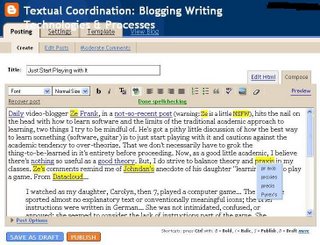
One feature of the beta version is a new "holistic" spell check. Rather than walking the user sequentially from the first to last suspect word, all suspect words are highlighted and become clickable for a drop-down menu of replacement options. I was pleased. I found the new spell-check easier to manage and easier for quickly assessing "real" and false-positive misspellings. While MS Word's on-the-fly red underlining is similar, I find this "highlight it when I say so" less intrusive during writing and the highlighting is easier to scan visually (better contrast), so I find it easier to scan. I'd be happy if this became a new standard.
If you meant the beta for the new Blogger, we are waitingUm, ok. It's the same feeling I get when my bank gets eaten by a bigger bank and I get issued a new, uglier ATM card or my phone service gets swallowed by a bigger phone service and I loose track of just who the hell my phone company is. Yes, there's probably myriad documentation that would let me know what's going on, but this end-user just wants to post. < /rant >
for more things to be in place from Blogger before it will
work.
One feature of the beta version is a new "holistic" spell check. Rather than walking the user sequentially from the first to last suspect word, all suspect words are highlighted and become clickable for a drop-down menu of replacement options. I was pleased. I found the new spell-check easier to manage and easier for quickly assessing "real" and false-positive misspellings. While MS Word's on-the-fly red underlining is similar, I find this "highlight it when I say so" less intrusive during writing and the highlighting is easier to scan visually (better contrast), so I find it easier to scan. I'd be happy if this became a new standard.

Wednesday, August 30, 2006
Just Start Playing with It
Daily video-blogger Ze Frank, in a not-so-recent post (warning: Ze is a little NSFW), hits the nail on the head with how to learn software and the limits of the traditional academic approach to learning, two things I try to be mindful of. He's got a pithy little discussion of how the best way to learn something (software, guitar) is to just start playing with it and cautions against the academic tendency to over-theorize. That we don't necessarily have to grok the thing-to-be-learned in its entirety before proceeding. Now, as a good little academic, I believe there's nothing so useful as a good theory. But, I do strive to balance theory and praxis in my classes. Ze's comments remind me of Johndan's anecdote of his daughter "learning" how to play a game. From Datacloud...
I watched as my daughter, Carolyn, then 7, played a computer game... The interface sported almost no explanatory text or conventionally meaningful icons; the brief instructions were written in German... She was not intimidated, confused, or annoyed; she seemed to consider the lack of instructions part of the game. She merely started the game and began clicking on objects...He includes a snippet of their conversation about the game:
(p.2)
J: How do you know which blocks to hit?Ze Frank is one of my favorite Internet Personalities. He's funny, very clever/innovative, and often provides something interesting to consider -- thinking so I don't have to.
C: I just... hit them.
[...]
J: So how do you figure out what the rules are?
C: Just play.
J: Just play? And then what happens?
C: You just... play.
(p. 3)
Subscribe to:
Posts (Atom)
